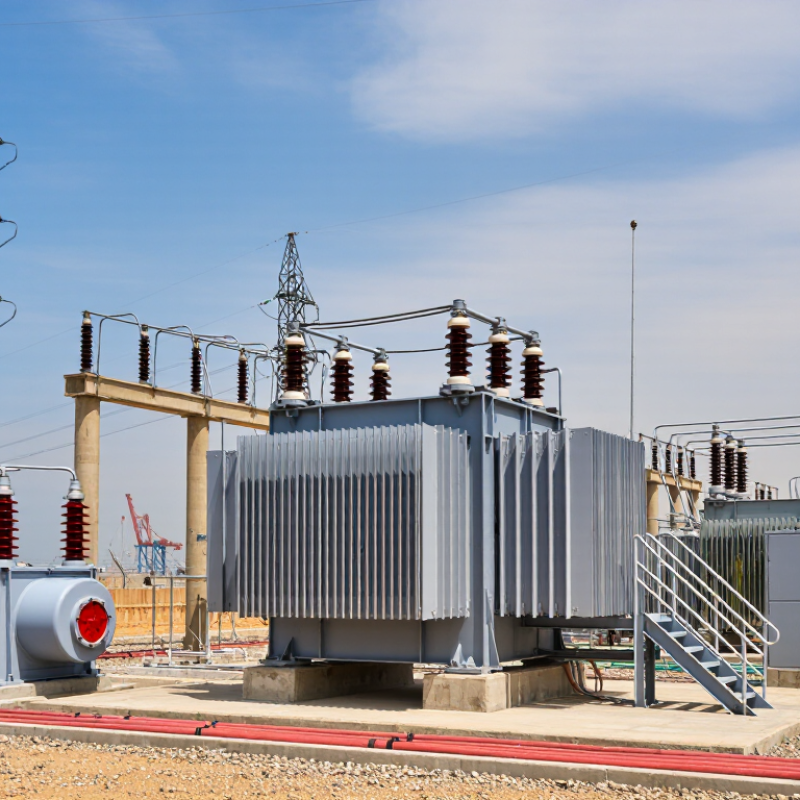
| Primary Insulation Medium | Mineral oil or less-flammable ester liquid provides insulation and transfers heat to the tank and cooling system. | Solid insulation, commonly cast resin or varnished insulation, with air as the external cooling medium. | Choose the insulation system according to fire risk, environmental requirements, maintenance capability, and installation location. |
| Typical Application | Outdoor substations, utility transmission and distribution networks, industrial substations, and high-capacity power systems. | Indoor substations, commercial buildings, hospitals, data centers, tunnels, renewable-energy facilities, and fire-sensitive sites. | Oil-immersed units are generally preferred for higher power and outdoor service; dry-type units are often preferred where indoor fire safety is critical. |
| Common Capacity Range | From small distribution ratings to several hundred MVA in large power transformers. The practical range depends on voltage level, cooling method, and grid requirements. | Commonly from several hundred kVA to approximately 20–30 MVA for substation applications; larger ratings are possible but less common. | Confirm the required continuous load, overload profile, short-circuit level, future expansion, and local utility specifications before fixing the rating. |
| Typical Voltage Capability | Suitable for medium-voltage through high-voltage and extra-high-voltage applications, subject to design and insulation coordination. | Most commonly used on low-voltage and medium-voltage systems, frequently up to 36 kV class; higher-voltage designs require specific verification. | For transmission or high-voltage substations, oil-immersed construction is normally the more established solution. |
| Cooling Methods | Common designations include ONAN and ONAF; larger units may use additional forced-oil or directed-oil cooling systems. | Common designations include AN and AF, meaning air natural and air forced cooling. | Compare the rated capacity under natural cooling first. Forced cooling may increase capacity but adds fans, controls, noise, and maintenance points. |
| Typical Temperature-Rise Classes | Many designs use approximately 55 K or 65 K average winding temperature rise, depending on the applicable standard and specification. | Common dry-type designs use temperature-rise classes such as 80 K, 100 K, or 120 K, depending on insulation system and manufacturer design. | Lower temperature rise can improve service life and overload margin but may increase size and cost. Use the project specification rather than comparing values without context. |
| Fire and Environmental Risk | Mineral oil is combustible and requires appropriate fire protection, oil containment, drainage, and separation. Ester liquids can provide a higher fire point than mineral oil. | No liquid insulation is present, so liquid-spill risk is eliminated. The resin and insulation system still require compliance with the required fire and smoke classification. | For buildings and restricted indoor spaces, dry-type or less-flammable-liquid designs may simplify risk assessment, subject to local fire codes. |
| Efficiency and No-Load Loss | Usually offers very high efficiency at medium and high ratings. No-load losses are influenced by core material, flux density, and operating voltage. | Can also achieve high efficiency, but enclosure ventilation, core design, and operating temperature affect performance. | Request guaranteed no-load loss, load loss, impedance, and total ownership-cost calculations at the specified tap and frequency. |
| Short-Circuit Withstand | Well-established for high fault levels when properly designed and braced; the required withstand duration and current must be specified. | Can provide strong short-circuit performance, but mechanical design, resin integrity, and support structure must be verified for the project fault level. | Specify the short-circuit current in kA, duration, system X/R ratio where applicable, and the applicable test or calculation requirements. |
| Noise Characteristics | Core magnetostriction, cooling fans, pumps, and tank vibration contribute to sound level. Forced cooling generally increases noise. | Core magnetostriction and cooling fans contribute to sound level. Natural-air designs may avoid fan noise during normal operation. | For urban, residential, and indoor projects, include a guaranteed sound-pressure or sound-power limit in the purchase specification. |
| Maintenance Requirements | May require liquid sampling, dissolved-gas analysis, leak inspection, bushing checks, pressure-relief-device checks, and cooling-system maintenance. | Generally avoids liquid testing and leak maintenance. Periodic inspection, cleaning, connection checks, temperature monitoring, and fan maintenance may be required. | Dry-type units can reduce routine liquid-related maintenance, while oil-immersed units may offer more established field-service practices for large substations. |
| Installation Space | Requires consideration of oil containment, fire separation, ventilation, access for lifting, and clearance around radiators and bushings. | Often suitable for compact indoor substations, but sufficient ventilation, clearance, enclosure access, and heat dissipation must be provided. | Compare the complete installation footprint, including containment, fire barriers, ventilation equipment, cable terminations, and maintenance access. |
| Altitude and Climate Adaptation | High altitude, low temperature, humidity, salt pollution, and solar heating may require derating or special design features. | High altitude reduces air density and cooling capability; humidity, condensation, dust, and pollution may require heaters, filters, or protective enclosures. | State the site altitude, minimum and maximum temperature, humidity, pollution level, seismic conditions, and solar exposure in the inquiry documents. |
| Protection and Monitoring | Common accessories include oil and winding temperature indicators, pressure relief devices, liquid-level indicators, Buchholz relays for applicable conservator designs, and online monitoring options. | Common accessories include winding temperature sensors, thermistors or RTDs, fan controllers, alarm contacts, and partial-discharge monitoring where specified. | Select protection based on transformer design, not only on transformer category. The final scheme must coordinate with the substation protection system. |
| Relevant International Standards | IEC 60076 series and IEEE C57 series are widely used. The applicable standard depends on the purchaser, country, voltage level, and utility requirements. | IEC 60076-11 is specifically applicable to dry-type power transformers, with other parts of IEC 60076 and regional standards also relevant. | Identify the governing standard edition, routine tests, type tests, special tests, tolerances, documentation, and inspection requirements in the contract. |
| Lifecycle Cost Factors | Purchase price, liquid management, fire protection, losses, cooling auxiliary power, inspections, and possible oil treatment influence total cost of ownership. | Purchase price, ventilation or fan power, room construction, cleaning, thermal management, losses, and replacement access influence total cost of ownership. | Evaluate capital cost together with 20–30-year energy losses, maintenance, downtime risk, civil works, and safety-system costs. |
| Best-Fit Summary | Best suited to high-capacity outdoor substations, high-voltage networks, utility applications, and projects prioritizing high power density. | Best suited to indoor or fire-sensitive installations, buildings with limited spill-control infrastructure, and medium-voltage applications near occupied areas. | Neither type is universally superior. The best choice depends on capacity, voltage, site conditions, fire strategy, noise limits, reliability targets, and lifecycle economics. |