
Choosing the right 4 Pin Female Connector in 2026 requires more than comparing prices or catalog photos. Global buyers must examine contact materials, mating cycles, voltage ratings, wire gauges, and environmental protection. A connector used inside a control cabinet faces different demands from one exposed to rain, vibration, or engine heat.
This guide introduces four practical connector types for international sourcing: wire-to-wire, wire-to-board, waterproof circular, and automotive-style connectors. Each option solves a different installation problem. Quick decisions can become expensive.
Real purchasing experience shows that small details often cause major failures. A loose crimp may pass an initial test but overheat after months of vibration. An attractive IP rating may apply only when the connector is fully mated. Some datasheets also present unclear current values, so buyers should request test conditions and samples.
Reliable evaluation should include terminal plating, housing temperature limits, locking design, sealing performance, and supplier quality records. Buyers should also check relevant IEC, UL, RoHS, and REACH documentation for their target markets. These references support responsible procurement, but they do not replace application testing.
The best connector is not always the most advanced one. It is the one that fits the cable, equipment, environment, and maintenance plan. A low-cost model may work perfectly in a dry enclosure. It may fail quickly outdoors. This comparison helps engineers, distributors, and purchasing teams reduce uncertainty before committing to volume orders. Minor mistakes remain possible, especially when specifications change between suppliers. Verification matters.
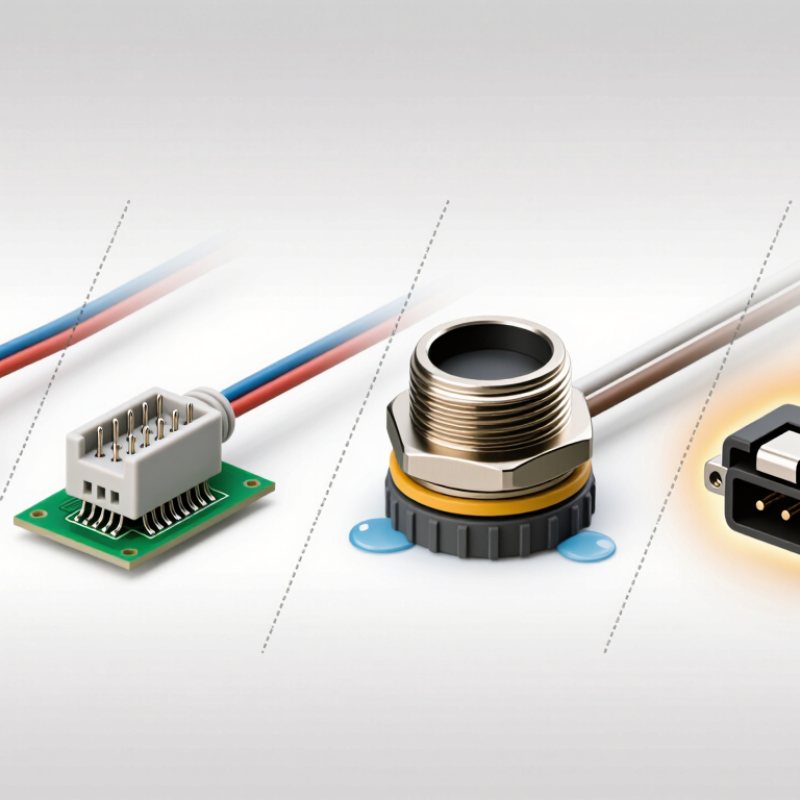
For global buyers, four-pin female connectors are best grouped by application: wire-to-board, wire-to-wire, circular industrial, and sealed automotive types. IEC 60512 does not define these families. It provides test methods for electrical, mechanical, and environmental performance. Key checks include contact resistance, insulation resistance, dielectric strength, mating durability, and termination security. A four-pin housing can look suitable, yet fail after repeated vibration.
Wire-to-board designs suit control panels and compact equipment. Wire-to-wire types support field replacement and harness extensions. Circular industrial connectors resist twisting and accidental pulling, especially near motors. Sealed automotive connectors add protection against water, dust, and thermal cycling.
According to Bishop & Associates’ 2024 connector industry analysis, the global connector market exceeded 80 billion dollars, showing why standardised testing matters across supply chains. Market estimates differ, though. That difference deserves scrutiny before purchasing.
Tips: Request IEC 60512 test records, not only catalogue ratings. Check the actual cable size, plating, locking force, and operating temperature. Ask for mating-cycle results with the chosen wire. In one practical review, a connector passed electrical tests but failed after poor crimp control. Small details matter. Also verify ingress protection through the complete assembly, not the female housing alone.
For global buyers, four practical 2.54 mm female connector options are open single-row housings, dual-row housings, shrouded friction-lock housings, and board-to-wire terminal blocks. This comparison focuses on open 2.54 mm crimp housings and shrouded friction-lock headers for 2–4 A circuits. The pitch is identical, but their field behavior differs.
Open housings are inexpensive, easy to inspect, and suitable for low-risk prototypes or protected equipment. However, they can loosen under vibration and allow reversed insertion. Shrouded housings guide the mating header and provide stronger retention. They suit control panels, compact power boards, and repeated service work. Still, a 4 A label can mislead. Contact material, wire size, temperature rise, and crimp quality decide the real limit. Bishop & Associates’ 2024 connector market report estimated the global connector market near 84 billion US dollars in 2023, showing why standardized parts remain important for international sourcing. Yet market size does not replace validation.
Tips: Use 22–24 AWG wire for many 2–4 A designs, then verify the datasheet. Test a mated sample at the highest ambient temperature. Check voltage drop after 30 minutes. Do not guess. I have seen a perfect-looking crimp fail after repeated flexing. That detail is easy to miss. Also confirm polarization, locking force, plating, and insulation clearance before approving a substitute.
Comparison of common 2.54 mm female connector configurations for 2–4 A low-voltage circuits.
Values show typical continuous current capability and a conservative design target. Actual performance depends on contact geometry, wire gauge, temperature rise, plating, housing ventilation, and the number of energized positions. Verify the manufacturer’s datasheet before final design approval.
For global buyers comparing four-pin female connectors, 2.50 mm pitch XH-style housings deserve careful attention. They suit compact PCB wiring where space is limited but service access still matters. The female housing usually accepts crimp terminals and mates with a matching board header. Its compact footprint helps keep four power or signal lines orderly.
In practical assembly, terminal crimp quality matters more than appearance. I check conductor insertion, insulation support, and gentle pull resistance before production approval. A loose crimp can create intermittent faults that testing may miss. The housing’s friction lock also needs a clear click and stable retention. Small detail. It prevents avoidable disconnection during vibration or maintenance.
Buyers should compare vertical and right-angle header layouts against the enclosure’s cable path. A right-angle version can reduce bending near the PCB edge. A vertical version may simplify automated placement and inspection. Confirm pitch, terminal plating, wire range, current rating, temperature limits, and mating cycles from controlled technical documents. Tolerance differences between suppliers can affect interchangeability, even when dimensions appear identical. I have seen prototypes pass bench tests but fail after repeated mating. That weakness deserves honest review. 2.50 mm connectors are compact, but they are not automatically suitable for high-current circuits. Use measured electrical data, not a catalog photograph, when selecting the final four-pin configuration.
| Connector Type | Typical Pitch | Typical Positions | Typical Current Capacity | Typical Voltage Rating | Locking / Retention | Best-Fit Application |
|---|---|---|---|---|---|---|
| 2.50 mm single-row friction-lock receptacle | 2.50 mm | 2–20 circuits; 4-pin versions are common | Approximately 2–3 A per contact with suitable wire and temperature rise | Approximately 100–250 V AC/DC, depending on insulation and creepage design | Housing friction lock; optional board or cable-side polarization | Compact PCB wiring, sensors, displays, fans, and low-power controls |
| 2.54 mm single-row latch receptacle | 2.54 mm | 2–40 circuits; 4-pin versions are widely available | Approximately 1–3 A per contact | Typically 100–250 V AC/DC | Positive latch or friction retention; polarized housing options | General embedded electronics, control boards, and cable harnesses |
| 2.00 mm low-profile receptacle | 2.00 mm | 2–30 circuits; 4-pin versions are available | Approximately 1–2 A per contact | Typically 50–125 V AC/DC | Friction retention or compact latch, depending on housing design | Space-constrained consumer electronics and compact instrumentation |
| 1.27 mm micro wire-to-board receptacle | 1.27 mm | 2–20 circuits; 4-pin versions are available | Approximately 0.5–1 A per contact | Typically 30–100 V AC/DC | Micro-latch, friction lock, or connector polarization | High-density PCB assemblies, portable devices, and miniature sensors |
For global buyers, 4-pin M12 A-coded female connectors remain practical for sensors, valves, and control equipment. Their threaded coupling supports stable connections in vibrating industrial environments. The female side normally contains socket contacts for a compatible male plug. Small detail, big consequence. A-coding reduces mismatching risks, but it does not replace circuit verification. Check pin assignments, cable size, current rating, voltage rating, and shielding requirements.
IEC 61076-2-101 defines important mechanical and interface requirements for M12 connectors. It helps buyers compare mating geometry across qualified suppliers. Still, compliance claims need evidence. Request dimensional drawings, test reports, declarations, and production samples. IP67 indicates dust-tight protection and resistance to temporary immersion under specified conditions. The rating usually applies only when the connector is fully mated, tightened, and properly sealed. An uncapped panel receptacle may not keep that protection. Not always obvious.
The four common female configurations include straight cable, right-angle cable, panel-mount, and field-attachable versions. Straight bodies suit open cable routes, while right-angle bodies reduce bend stress inside crowded cabinets. Panel mounts require careful gasket compression and rear sealing. Field-attachable models offer flexibility, yet assembly quality can determine the final IP result. During inspection, check threads, O-rings, contact alignment, continuity, and insulation resistance. A connector may pass a laboratory test but fail after rough installation. I would treat IP67 as a complete installation result, not merely a printed label.
Four-pin female connectors commonly include wire-to-board, board-to-board, panel-mount, and sealed circular designs. Each type suits a different installation condition.
Wire-to-board versions support compact control cabinets and sensor assemblies. Board-to-board types save space inside equipment. Panel-mount connectors need strong locking features. Sealed circular connectors protect contacts from dust and moisture.
For global sourcing, verify the housing’s UL 94 V-0 rating through current test evidence, not a sales claim. Check whether the flame rating applies to the exact resin and connector series.
RoHS documentation should identify restricted substances and controlled materials. REACH declarations need an updated substance assessment and supplier responsibility statement.
Ask for drawings, material certificates, electrical ratings, and batch traceability. Requirements can vary by destination and application.
A familiar certificate may still be incomplete. That is worth questioning.
Tips:
Request samples from the intended production lot. Inspect pin alignment, insertion force, plating condition, and locking performance.
Test mating cycles under realistic temperature and load conditions. Confirm packaging prevents bent contacts during long-distance shipping.
Keep records in one technical file. A small omission can delay customs or approval.
In my experience, suppliers sometimes provide old declarations without noticing the revision date. Recheck every document before purchase.
Please enter the details to download, thank you
Get in Touch With Us
Please enter the details to download, thank you