
The 2026 market for Black Uhmw Plastic is becoming more specialized, practical, and demanding. Global buyers now compare more than price and color. They examine wear resistance, impact strength, dimensional stability, machinability, and supply consistency. A black wear strip may look simple, yet its performance depends on resin quality, carbon-black dispersion, thickness, and operating temperature.
Dr. Steven M. Kurtz, a recognized UHMWPE materials specialist, captures the selection challenge clearly: “The best material is the one that meets the application’s demands without unnecessary compromise.” This principle matters when choosing Black Uhmw Plastic for conveyor guides, truck-bed liners, marine components, or outdoor machine parts. Virgin grades can offer cleaner consistency. Reprocessed grades may reduce cost, but their history requires careful verification. Conductive or reinforced options can solve specific problems, though they may complicate machining and purchasing.
No grade wins everywhere. That is easy to forget. In 2026, leading suppliers are expected to provide clearer technical data, tighter lot control, and stronger documentation for international buyers. Important checks include density, coefficient of friction, impact performance, temperature limits, sheet thickness tolerance, and certificate traceability. Buyers should also confirm whether the black pigment affects heat absorption in outdoor service.
Some decisions remain imperfect. Supplier data may use different test methods. Real-world results can also differ from laboratory figures. Therefore, this guide compares the top Black Uhmw Plastic types through both technical evidence and practical purchasing experience. The goal is straightforward: help buyers match each grade with its actual working environment, not merely its product description.
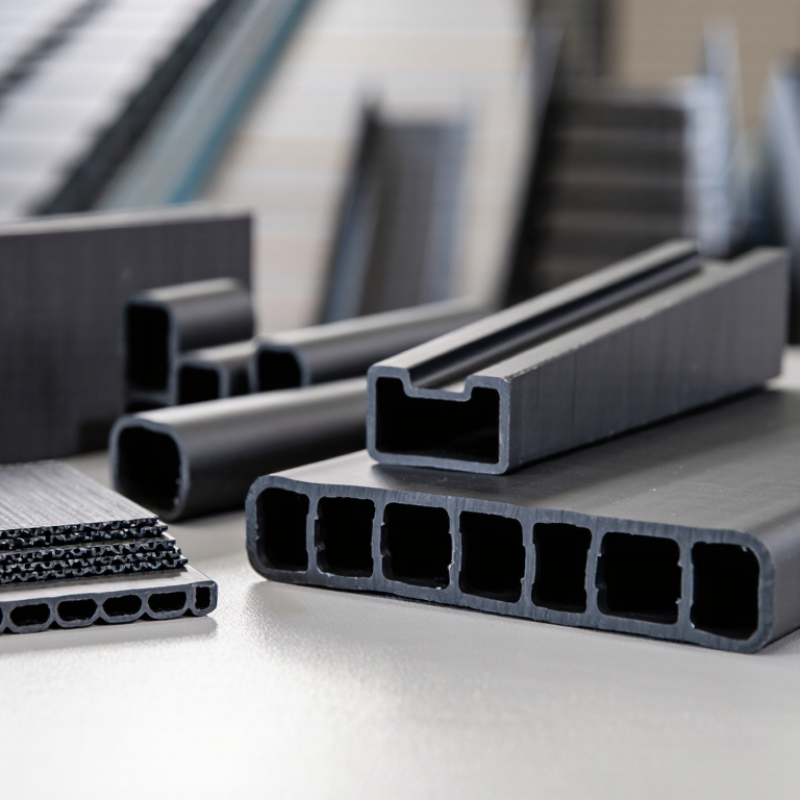
Black UHMW-PE is an ultra-high-molecular-weight polyethylene with a carbon-black-based appearance. Its molecular weight typically ranges from 3 to 9 million g/mol. This figure describes the average length of its polymer chains. Longer chains usually support strong abrasion resistance, impact strength, and low sliding friction.
It is not just a color. Carbon black can improve resistance to sunlight and weathering, but the result depends on dispersion and formulation. Black UHMW-PE may be supplied as sheets, liners, wear strips, guide rails, or machined parts. In a bulk-handling chute, a smooth black liner can reduce material buildup. In a conveyor guide, its low friction may help protect moving surfaces.
Buyers should request the molecular-weight range, density, hardness, and abrasion data. Test methods must be checked carefully. Different laboratories may report different results. A certificate alone is not enough for every application. Ask for a production sample and inspect its surface for voids, streaks, or uneven coloring. That detail matters.
Temperature is another practical concern. UHMW-PE performs well in many low-temperature applications, but continuous heat can reduce stiffness and dimensional stability. Machining also needs care because internal stress may cause slight warping. I have seen specifications focus heavily on molecular weight while ignoring installation support. That is a mistake worth reconsidering. The best grade depends on load, sliding speed, temperature, moisture, and expected wear—not color alone.
Black UHMW plastic is widely selected when outdoor durability and visual consistency matter. Carbon black absorbs ultraviolet energy and helps protect UHMWPE from sunlight-driven chain damage. However, not every black grade provides the same protection. Particle size, surface area, structure, and dispersion strongly influence performance.
A 10% loading can improve UV resistance while preserving relatively manageable melt behavior. Higher loadings, often between 20% and 30%, may support stronger conductivity and deeper color. Conductive performance depends on particle networking, not carbon content alone. Poor dispersion can create weak spots, uneven surfaces, and unreliable electrical readings. It can also increase processing torque and reduce impact performance.
For global buyers, test plaques should be molded using the intended production method. Measure surface resistance, tensile strength, elongation, abrasion, and color stability after UV exposure. Ask for batch-level data and confirm the carbon black loading by technical documentation. A grade that performs well in a laboratory may behave differently in thick pipe walls or machined sheets. This is easy to overlook. Processing temperature, cooling speed, and moisture control also affect final consistency. Some applications need conductivity; others only need UV shielding. Treating both requirements as identical can lead to unnecessary cost or disappointing service life.
For global buyers in 2026, black UHMW-PE sheet remains a practical choice for demanding wear applications. Its low-friction surface helps reduce sliding resistance and material buildup. Under suitable conditions, its wear rate can be up to 10 times lower than steel. The result depends on load, speed, surface hardness, and contact pressure.
Black UHMW-PE often protects conveyor chutes, hopper liners, guide rails, and material-handling surfaces. Carbon black can improve resistance to ultraviolet exposure, which matters for outdoor installations. The sheet also absorbs impact without denting as easily as many rigid metals. It is lighter than steel, so installation may require fewer lifting resources. That difference is significant.
But the comparison needs care. A wear claim without test conditions is incomplete. Abrasive sand, sharp particles, heat, and poor fastening can reduce service life quickly. A practical buyer should request abrasion data, dimensional tolerances, temperature limits, and inspection records. Check thickness across the sheet, not only one corner. Small variations can affect liner alignment. Machining is generally straightforward, yet unsupported sections may flex during cutting. This is often overlooked. Engineers should also review creep under continuous loads and confirm compatibility with the working environment. A lower purchase price may not deliver lower operating cost. Real performance must be measured against the actual duty cycle.
Typical selection data for black ultra-high-molecular-weight polyethylene (UHMW-PE) sheet and machined components
| Black UHMW-PE Type | Primary Construction or Feature | Typical Density | Typical Mechanical Data | Friction and Wear Performance | Operating Temperature | Typical Global Applications |
|---|---|---|---|---|---|---|
| Standard Black UHMW-PE | Virgin UHMW-PE resin with black pigment for general-purpose wear protection and light shielding. | 0.93–0.95 g/cm³ | Tensile yield strength: approximately 20–28 MPa Shore D hardness: approximately 55–70 | Coefficient of friction: approximately 0.10–0.22 Up to 10× lower wear than steel in selected tests | Approximately −100 to +80°C continuous service; short-term limits depend on load and design. | Chute liners, hopper liners, conveyor wear strips, guide rails, impact pads, and general material-handling equipment. |
| UV-Stabilized Black UHMW-PE | Black UHMW-PE formulated with UV stabilizers for improved outdoor weathering performance. | 0.93–0.96 g/cm³ | Tensile yield strength: approximately 20–28 MPa Low moisture absorption and good impact resistance | Coefficient of friction: approximately 0.10–0.22 Good abrasion resistance under outdoor service conditions | Approximately −100 to +80°C continuous service; UV exposure can still affect service life over time. | Outdoor conveyors, bulk-material handling, agricultural equipment, marine components, truck bed liners, and exposed architectural panels. |
| Antistatic Black UHMW-PE | Black UHMW-PE modified to reduce static charge accumulation while retaining low-friction wear properties. | Typically 0.94–0.98 g/cm³ | Mechanical values vary by formulation; tensile yield strength commonly remains within approximately 18–27 MPa. | Coefficient of friction: approximately 0.12–0.25 Surface resistance is commonly specified in the 109–1012 Ω range. | Approximately −80 to +80°C, subject to the specific conductive or antistatic formulation. | Dust-sensitive conveying, packaging lines, electronic-material handling, powder processing, and areas requiring reduced static buildup. |
| Electrically Conductive Black UHMW-PE | UHMW-PE containing conductive carbon-based additives to provide a controlled path for static dissipation. | Typically 0.96–1.02 g/cm³ | Strength and elongation are generally lower than unfilled UHMW-PE and depend strongly on additive loading. | Coefficient of friction: approximately 0.12–0.28 Surface resistance may range from approximately 104 to 109 Ω. | Commonly approximately −60 to +80°C; confirm the grade for continuous high-temperature use. | Grounded wear liners, conveyor components, static-control chutes, industrial automation, and bulk-powder handling systems. |
| Oil- or Lubricant-Modified Black UHMW-PE | UHMW-PE formulated with internal lubricating additives to reduce friction and improve sliding behavior. | Approximately 0.94–0.98 g/cm³ | Tensile yield strength: commonly approximately 18–26 MPa Designed for low-friction motion rather than maximum strength. | Coefficient of friction: approximately 0.08–0.18 Suitable for dry-running or marginally lubricated sliding interfaces. | Approximately −80 to +80°C, depending on additive chemistry and applied load. | Bearings, wear pads, sliding guides, chain guides, rollers, bushings, and reciprocating machine components. |
| High-Impact Black UHMW-PE | Impact-focused UHMW-PE grade selected for high toughness, low-temperature impact resistance, and abrasion protection. | 0.93–0.96 g/cm³ | Very high impact resistance; tensile yield strength commonly approximately 20–28 MPa. | Coefficient of friction: approximately 0.10–0.23 Excellent resistance to impact, gouging, and sliding abrasion. | Approximately −100 to +80°C; low-temperature toughness is a major selection advantage. | Rock and aggregate chutes, mining liners, snowplow components, bulk-material bins, truck liners, and impact barriers. |
Technical note: Values are typical engineering ranges rather than guaranteed specifications. Wear performance depends on counterface material, load, speed, temperature, lubrication, abrasive particle size, and test method. The “up to 10× lower wear than steel” comparison applies only to selected operating conditions and should not be treated as a universal design value. Confirm the exact grade, certification, sheet thickness, and test data with the material supplier before production use.
Black UHMW-PE rods look dimensionally stable, but heat and machining stress can change that impression. During turning, use sharp, polished tools and light cuts to limit surface smearing. A practical starting tolerance is ±0.10 mm for small diameters, subject to rod size and supplier capability. Larger sections may require ±0.20–0.30 mm. These figures are not universal.
Machining near the final size is safer after the rod reaches workshop temperature. Measure it at 20–23°C with calibrated equipment. UHMW-PE expands considerably more than metals, so a cold measurement can mislead the assembly designer. One common mistake is treating a catalogue tolerance as a guaranteed fit. It is not. For press fits, sliding bushes, or long shafts, buyers should request actual inspection data and define the measurement method.
The 150–180°C range requires serious caution. It is not a normal continuous service range for standard UHMW-PE. The material may soften well before 150°C, while its melting range is commonly near 130–136°C. At 180°C, rapid deformation, surface damage, and loss of mechanical strength are likely. Black colour does not automatically improve heat resistance. A rod beside a hot bearing may look intact while its bore slowly creeps. Short, controlled exposure might be acceptable in a specific design, but only after testing under load. Otherwise, the temperature requirement needs reconsideration.
In 2026, black UHMW plastic selection depends on more than color, thickness, and wear resistance. Global buyers should compare virgin, reprocessed, and modified grades against the required compliance pathway. Virgin UHMW usually offers the clearest documentation. Reprocessed material may reduce cost, but its composition and traceability need closer review. Black pigment matters. Carbon-based additives can affect food-contact eligibility, electrical behavior, and surface performance.
FDA compliance is application-specific.
It depends on the formulation, additives, processing method, and intended contact conditions. Ask for a current food-contact declaration and supporting test records. Do not treat “FDA compliant” as a universal claim. ASTM standards usually describe material properties and test methods, such as impact strength, tensile behavior, density, or wear resistance. They help buyers compare batches objectively. They do not automatically confirm food-contact approval.
ISO references require careful reading.
An ISO quality certificate may confirm controlled manufacturing, not product safety. An ISO test method can support performance comparisons, but it is not the same as regulatory acceptance. Request the exact standard number, revision date, lot number, and laboratory details. Check whether the report covers black resin, not only natural material. A small gap here can become a costly mistake. For critical applications, independent verification is sensible, even when supplier paperwork appears complete.
Please enter the details to download, thank you
Get in Touch With Us
Please enter the details to download, thank you