
Ceramic Ball selection begins with the job, not the catalog. A ball rolling through a precision bearing faces different demands from one grinding minerals in a mill. Heat, impact, chemical exposure, load, and surface finish all matter. So does cost. No single ceramic suits every application.
The main types include alumina, zirconia, silicon nitride, silicon carbide, and steatite. Alumina is widely used and often offers a practical balance of hardness and price. Zirconia is notably tough, while silicon nitride is valued for low density and strong performance in demanding bearings. Silicon carbide handles high temperatures and abrasive conditions. Steatite can suit less demanding, cost-sensitive uses. Details vary by grade and manufacturer.
A brief note on attribution: no verified expert quotation was supplied, so the following is an illustrative statement, not a sourced quote. Fictional ceramic-materials specialist Dr. Elena Park puts the selection principle this way: “Choose the ceramic for the operating conditions, not just its headline hardness.” A useful reminder. A harder ball may still be the wrong choice if impact resistance, lubrication, or dimensional tolerance is overlooked. Even a careful shortlist can miss a real-world detail; test data and application-specific advice should guide the final choice.
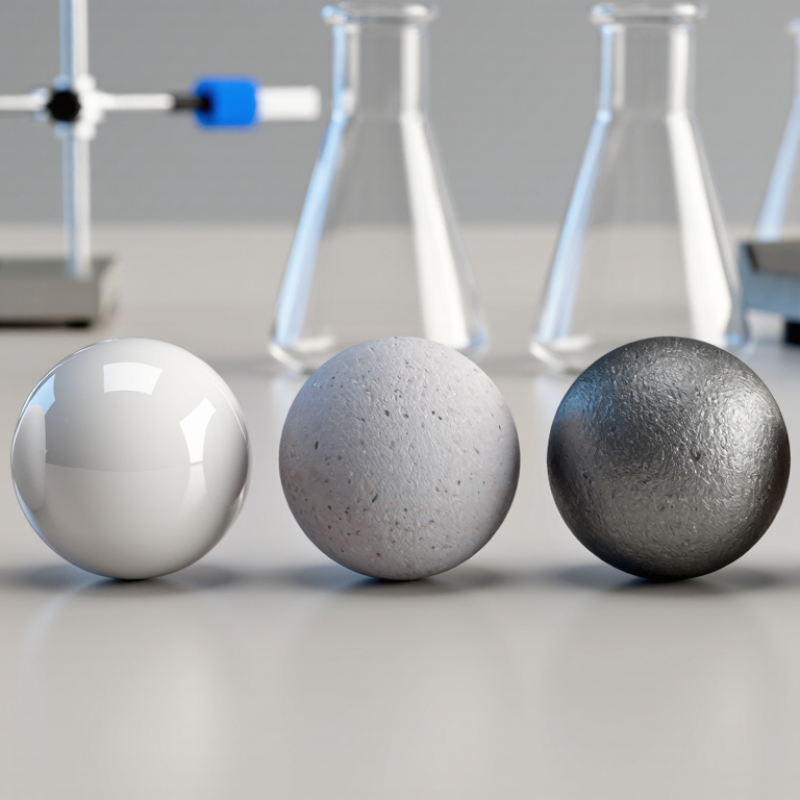
Ceramic balls are commonly classified by composition, intended use, and dimensional precision. Composition is often the quickest way to compare them. Alumina Balls are widely used as grinding media because they resist wear and many chemicals. Zirconia offers greater toughness, making it useful in demanding wear applications. Silicon nitride is lightweight and tolerates high temperatures, while silicon carbide is valued for hardness and heat resistance.
The categories overlap more than a simple list suggests. A ball’s performance also depends on purity, density, porosity, diameter, and surface finish. For example, two alumina balls may behave differently if one has more pores or a rougher surface. That matters.
Classification by application helps narrow the choice: grinding media, bearing elements, and valve components face different loads and operating conditions. A grinding ball must withstand repeated impacts; a bearing ball needs consistent size and a smooth finish.
Precision grades describe dimensional variation and roundness, not the ceramic’s chemistry. I would not rank materials by hardness alone. It is easy to overlook operating temperature, lubrication, or contact stress when comparing specifications. The best category depends on the actual job, and a material name by itself rarely tells the whole story.
Alumina ceramic balls are used in milling, mixing, and selected industrial filling applications. Their high hardness helps them resist wear during repeated contact with minerals or powders. They are also chemically stable in many process environments, though compatibility depends on the material being handled. Small details matter.
In a grinding mill, ball diameter affects how energy reaches the material. Smaller balls can help process fine particles, while larger ones may suit coarser feed. The right choice also depends on mill speed, slurry consistency, and the desired particle size. A very hard ball is not automatically the best option. If it chips or wears unevenly, it may add unwanted fragments to the product.
Before selecting alumina balls, check their stated alumina content, density, and size tolerance. These properties can vary by grade and influence wear, impact resistance, and contamination risk. Inspect a sample for visible cracks or chipped edges, then monitor ball wear during a controlled trial. I would avoid relying on appearance alone; performance data from the actual mill is more useful. Keep records of feed material, operating time, and changes in particle size.
What Are the Top Types of Ceramic Balls?
Zirconia Ceramic Balls
Zirconia ceramic balls are valued for hardness, corrosion resistance, and smooth, consistent surfaces. Typical yttria-stabilized zirconia data sheets report density near 6.0 g/cm³ and hardness around 1,200 HV; exact values depend on grade and test method. In a pump, these balls can tolerate many corrosive fluids better than steel. Yet they are not immune to damage. A sharp impact or poor fit may cause chipping.
The market context is growing, but broad figures need careful reading. Grand View Research’s Advanced Ceramics Market Size Report estimated the global advanced ceramics market at USD 11.8 billion in 2023, with projected growth through 2030. That figure covers many products, not zirconia balls alone. For selection, engineers should check ball grade, size tolerance, surface finish, load, and operating temperature. A datasheet number can look reassuring; real performance still depends on the assembly.
Tips: Ask for a lot-specific inspection report. Check roundness and surface defects under good lighting. Small flaws matter. And reconsider zirconia where sudden impact is likely.
| Ceramic Ball Type | Typical Material | Approximate Density | Key Characteristics | Common Applications |
|---|---|---|---|---|
| Zirconia | Zirconium dioxide, commonly stabilized with yttria or magnesia | About 5.7–6.1 g/cm³ | High toughness and wear resistance; a dense, smooth surface; good corrosion resistance in many environments. Properties depend on the stabilizer and grade. | Precision bearings, valves, pumps, grinding media, and applications requiring high wear resistance. |
| Alumina | Aluminum oxide, often supplied in high-purity grades | About 3.6–3.9 g/cm³ | High hardness, electrical insulation, and good chemical stability. Generally less tough than zirconia. | Grinding and milling, chemical-processing equipment, insulating components, and general-purpose wear parts. |
| Silicon nitride | Silicon nitride (Si₃N₄) | About 3.2–3.3 g/cm³ | Low density, high strength, good thermal-shock resistance, and strong performance in high-speed rolling-contact applications. | Hybrid bearings, high-speed machinery, and components exposed to heat or demanding operating conditions. |
| Silicon carbide | Silicon carbide (SiC) | About 3.1–3.2 g/cm³ | Very high hardness, excellent thermal conductivity, and strong resistance to heat and many corrosive environments. Brittle under impact. | High-temperature equipment, seals, specialized wear components, and selected grinding applications. |
| Steatite | Magnesium silicate-based ceramic | About 2.7–2.9 g/cm³ | Good electrical insulation and comparatively economical; typically less hard and wear-resistant than zirconia or high-purity alumina. | Electrical insulation, general-purpose components, and applications with moderate wear requirements. |
| Mullite | Aluminosilicate ceramic | About 2.8–3.2 g/cm³ | Good thermal stability and resistance to thermal shock; properties vary with composition and manufacturing method. | High-temperature industrial equipment and applications involving repeated heating and cooling. |
| Density figures are approximate and vary by composition, porosity, and manufacturing grade. Select a ceramic ball based on operating load, speed, temperature, chemical exposure, and required precision. | ||||
Silicon nitride ceramic balls are valued for low mass, high hardness, and resistance to heat and wear. ASM International’s Engineered Materials Handbook, Volume 4: Ceramics and Glasses, lists typical silicon nitride density near 3.2 g/cm³ and hardness around 14–18 GPa. For comparison, steel is roughly 7.8 g/cm³. In a high-speed bearing, lighter balls can reduce centrifugal loading; the difference is tangible when a spindle runs hot for hours. That matters. ISO 26602:2017 also specifies silicon nitride materials for rolling bearings, reflecting their established engineering use.
Performance still depends on the grade, ball finish, bearing design, and lubrication. Silicon nitride is hard, but it is not immune to impact damage. Its fracture toughness is commonly reported around 5–8 MPa√m in ceramic engineering references, below many metals. A chipped ball can damage its raceway, so handling and installation deserve care. It may also cost more than steel and offer little benefit in a slow, lightly loaded assembly. Not always. The useful choice is application-specific: engineers should check supplier test data for the exact grade, rather than treating handbook ranges as guarantees.
Silicon carbide ceramic balls are valued for their hardness, low weight, and resistance to heat and wear. Compared with steel balls, they are lighter and can perform well in demanding, abrasive environments. Their thermal conductivity also helps move heat away from contact points. These properties make them a consideration for precision bearings, pumps, valves, and mechanical seals, especially where corrosion or high operating temperatures challenge other materials.
Still, silicon carbide is not automatically the best choice. It is hard, but brittle; a sharp impact or poor alignment can cause chipping or fracture. Small chips matter. In a pump, for example, they may affect sealing or accelerate wear on nearby parts. Selection should account for ball diameter, roundness, surface finish, load, lubrication, and temperature—not just the material name. It is tempting to focus on hardness alone, but operating conditions tell a more complete story. A careful comparison with other ceramic options and steel can help determine whether silicon carbide’s performance justifies its cost and handling requirements.
Please enter the details to download, thank you
Get in Touch With Us
Please enter the details to download, thank you