
Choosing High Quality Cabinet Hardware is more than matching handles to cabinet colors. It affects daily comfort, durability, and the finished appearance of a room. A pull may look attractive in a product photo, yet feel sharp, loose, or poorly balanced after installation. Careful selection begins with practical details, not decoration alone.
Experienced installers usually examine the metal, fastening system, surface finish, and overall weight. Solid brass, stainless steel, and high-grade zinc alloys can offer dependable performance when properly manufactured. Check whether the mounting screws fit firmly and leave enough thread inside the cabinet door. A drawer pull should sit steadily without twisting under regular use. Open and close the cabinet repeatedly. Notice the grip.
Finish matters, too. Brushed surfaces can hide fingerprints, while coated finishes may resist moisture in kitchens and bathrooms. However, no finish is completely maintenance-free. Even experienced buyers can overlook weak screw threads or uneven plating. That is worth remembering. Reliable suppliers should provide clear dimensions, material information, installation guidance, and warranty terms. Independent testing or documented quality control can strengthen confidence, although marketing language alone proves very little.
Before purchasing, compare the hardware with your cabinet thickness, room conditions, and expected usage. A small knob may suit a light bedside cabinet but feel uncomfortable on a wide kitchen drawer. Measure twice. Then inspect every piece before installation. This practical approach helps homeowners, designers, and contractors choose cabinet hardware that looks refined and performs consistently over time.
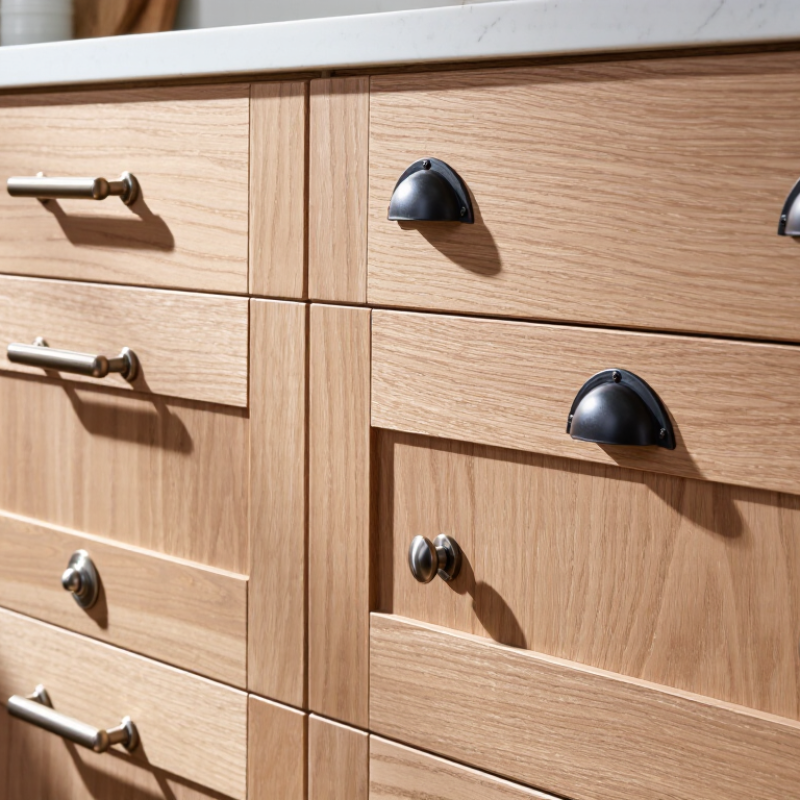
High-quality cabinet hardware begins with its core features, not its finish. In the 2024 NKBA Kitchen Trends Report, designers continue to emphasize durable, easy-care materials in busy kitchens. That makes substrate and construction important. Solid brass, stainless steel, or reinforced zinc usually feels denser than thin stamped metal. Check the mounting plate, screw threads, and moving joints. A handle should sit firmly without twisting.
Function reveals quality quickly. Drawer slides should open smoothly, remain aligned, and resist side-to-side movement. Hinges need controlled closing and consistent adjustment. The ANSI/BHMA A156.9 standard provides performance testing for cabinet hardware, including repeated operation and load resistance. Ask for test details, not just a “premium” label. That phrase proves very little.
Surface protection matters, especially near sinks and cooktops. Look for finishes tested against corrosion, humidity, and household cleaners. ASTM B117 salt-spray testing can indicate resistance, but laboratory results do not perfectly predict every home. Real kitchens are messier. Wipe marks, loose screws, and sharp edges become obvious after months of use. I would inspect a sample under strong light and operate it repeatedly. Small flaws count. A beautiful pull that loosens after installation is not high quality.
Material strength is an important indicator of durability, especially for frequently used handles, knobs, hinges, and pull-out components. Stainless steel grades generally provide higher tensile strength and strong corrosion resistance, while zinc alloy and aluminum offer lighter-weight alternatives.
The chart shows representative ultimate tensile strength values in megapascals (MPa). Stainless steel values are based on minimum requirements commonly specified for 304 and 316 stainless steel sheet, while zinc alloy and aluminum values are typical values that vary by alloy grade and temper. When selecting hardware, also verify corrosion resistance, load rating, surface finish, installation quality, and tested service cycles.
How to Choose High Quality Cabinet Hardware?
Material choice shapes durability. Stainless steel resists moisture, while solid brass offers greater weight and machining flexibility. Zinc alloy can reduce cost, but thin castings may feel brittle around screw holes. I check those holes first.
The 2024 Houzz U.S. Kitchen Trends Study reports that 76% of renovating homeowners replaced cabinet doors or fronts. That change increases the importance of compatible pulls, hinges, and mounting positions. For daily-use drawers, choose stainless steel or solid brass with secure threads. Avoid hollow handles that flex when pulled. A 2023 NKBA Design Trends report also identifies mixed metals as a continuing kitchen preference, yet visual appeal should not replace testing.
Finish quality needs measurable evidence. PVD coatings usually bond more consistently than basic sprayed finishes, but suppliers should disclose testing methods. ASTM B117 salt-spray testing helps compare corrosion resistance; it does not reproduce every kitchen environment. ISO 9227 offers a related laboratory framework. Ask for test duration, substrate, coating thickness, and failure criteria. Five hundred hours sounds impressive. It may still be incomplete.
Edges should feel smooth, not sharp. Threads should engage without wobbling. I once rejected attractive pulls because several screws arrived mismatched. That small error revealed weak quality control. Manufacturing records, dimensional checks, and batch inspection matter more than a polished product photograph. Still, no finish is permanent. Steam, abrasive cleaners, and wet hands gradually expose weak coatings, so care instructions deserve the same attention as material claims.
Choosing high-quality cabinet hardware starts with accurate measurements, not appearance alone. Measure the cabinet door thickness, drawer front, and existing hole spacing before ordering replacements. A handle that looks suitable may feel awkward if its center-to-center distance is wrong. For new cabinets, mark drilling points with a template and test the grip at standing height.
Fit also depends on clearance. Check the space between neighboring doors, walls, countertops, and handles. Oversized pulls can strike adjacent panels or block opening angles. Small knobs may suit narrow doors, but deep drawers usually need longer pulls for balanced force.
I once selected attractive handles that caught on clothing near a tight walkway. The mistake was functional, not visual.
Tips: Hold a sample against the cabinet first. Open every door and drawer. Check screw length, thread type, and mounting depth. Hardware should sit firmly without crushing the panel. For humid rooms, inspect the finish and exposed edges carefully. Compatibility with hinges, drawer slides, and soft-close mechanisms also matters. If installation feels forced, reconsider the hardware. A minor mismatch can become daily frustration, and measurements are easy to underestimate.
Choosing high-quality cabinet hardware requires more than checking its finish.
The 2024 Houzz U.S. Kitchen Trends Study reports that 76% of renovating homeowners upgraded their cabinets. That makes hardware a frequently handled component, not a minor decoration. Test each drawer slide with a full load. It should open smoothly without grinding, side movement, or sudden closing. Hinges should hold the door evenly after repeated opening. ANSI/BHMA A156.9 provides industry procedures for cabinet hardware, including cycle, load, and corrosion performance tests. Ask suppliers for current test documentation, not only attractive product photographs.
Installation quality strongly affects everyday performance.
Measure screw length, mounting-hole spacing, and door thickness before ordering. A small mismatch can make a solid pull feel weak. I once saw a drawer become difficult to close because one screw was tightened too aggressively. The hardware was not the real problem. Uneven installation was.
After fitting, open every door several times and listen for clicking, rubbing, or loose movement. These details often reveal failures before daily use exposes them.
Tips:
Choose corrosion-resistant finishes near sinks or dishwashers. Check whether screws match the cabinet material. Test drawers with realistic weight, not an empty box. Keep spare screws; they disappear easily. A laboratory pass does not guarantee perfect home performance. Temperature, moisture, and careless fitting still matter.
Reliable cabinet hardware begins with the supplier, not the showroom sample. During practical inspections, I check three matching samples: a hinge, a drawer slide, and a handle. Their plating should look even, with no cloudy edges or sharp burrs. I also request salt-spray results, load ratings, cycle-test records, and material specifications. A supplier should explain testing methods clearly. If answers remain vague, the attractive finish means little.
Houzz’s 2024 U.S. Kitchen Trends Study reports that 76% of renovating homeowners upgrade their cabinets. This suggests strong demand for dependable hardware, not merely decorative parts. The International Organization for Standardization recorded 1,265,216 valid ISO 9001 certificates worldwide in 2022. Certification can indicate controlled processes, but it is not proof of perfect products. I still compare batch records, inspection plans, replacement policies, and complaint response times.
Total value includes service, installation time, maintenance, and failure risk. A cheaper hinge may become expensive after misalignment, noise, or repeated replacement. Ask for a sample batch before ordering thousands. Test doors under realistic weight, temperature changes, and repeated opening. Keep written results. I have seen polished samples hide weak springs and inconsistent screw holes. That mistake is easy to make. Delivery reliability also matters. Check lead-time history instead of trusting one promised date. Suppliers should provide traceable packaging, clear tolerances, and spare-part availability. The best choice may cost more initially, yet reduce adjustments and callbacks. Even then, I would review the decision after six months of use.
| Evaluation Dimension | Recommended Weight | Reliable Quality Benchmark | What to Verify with the Supplier | Value Assessment |
|---|---|---|---|---|
| Base Material | 15% | Material should match the application. Common choices include stainless steel for moisture resistance, brass for decorative durability, and zinc alloy for complex shapes and controlled cost. | Request the material specification, alloy or grade, supplier declaration, and representative sample. Confirm that the declared material is consistent across the full order. | Prefer clearly specified materials over vague terms such as “metal” or “premium alloy.” |
| Corrosion Resistance | 15% | Finishes should be evaluated according to the intended environment, especially kitchens, bathrooms, coastal areas, and commercial spaces. Neutral salt spray testing can be performed under ISO 9227, but acceptance hours must be agreed by finish and use case. | Ask for an independent or traceable test report stating the test method, exposure time, substrate, coating system, and corrosion rating. | Do not compare salt-spray hours unless the test conditions and rating method are identical. |
| Finish Consistency | 12% | Visible surfaces should have uniform color, gloss, texture, edge coverage, and adhesion, without blistering, peeling, pinholes, sharp burrs, or exposed base metal. | Approve a signed or retained reference sample. Define acceptable color variation, surface defects, inspection lighting, and inspection distance in the purchase specification. | Consistent finish reduces installation rejects and improves the perceived value of the entire cabinet. |
| Load Capacity and Structural Strength | 15% | Handles, knobs, brackets, and support fittings should withstand the expected static and repeated loads without cracking, loosening, permanent deformation, or pull-out. | Request product-specific load data and test conditions. Confirm the mounting hardware, screw size, substrate, tightening torque, and safety factor used in the test. | Use the stated capacity only when it reflects the complete installed assembly, not the part alone. |
| Operating Cycle Life | 12% | Moving components such as hinges, slides, catches, and lift mechanisms should be tested through repeated opening and closing cycles appropriate to their application. | Obtain the cycle count, test load, test speed, adjustment limits, failure criteria, and whether the result applies to the exact model being purchased. | Longer verified cycle life generally offers better value in frequently used residential or commercial cabinetry. |
| Dimensional Accuracy and Compatibility | 10% | Hole spacing, mounting depth, screw position, plate alignment, and component tolerances should match the approved technical drawing. Common handle center-to-center sizes include 96 mm and 128 mm, but the required size depends on the cabinet design. | Review dimensioned drawings and first-article samples. Check interchangeability with the specified doors, panels, hinges, drawer systems, and installation tools. | Accurate dimensions reduce rework, misalignment, drilling errors, and installation labor. |
| Ergonomics and Safety | 8% | Frequently touched parts should have comfortable grip geometry, smooth edges, secure fastening, and no accessible sharp projections or pinch hazards under normal use. | Conduct a physical sample review for grip comfort, edge condition, movement smoothness, clearance, and screw retention. | A slightly higher purchase price can be justified when the fitting improves daily usability and reduces safety complaints. |
| Supplier Quality System | 6% | A dependable supplier should use documented incoming inspection, in-process controls, final inspection, nonconformity handling, and lot traceability. | Request a quality manual or process overview, inspection records, corrective-action examples, and the sampling plan used for finished goods. | Process control is more reliable than judging quality from a single attractive sample. |
| Packaging and Logistics Protection | 4% | Packaging should prevent scratching, finish contact, deformation, moisture exposure, and mixing of different sizes or finishes during transport. | Review packaging samples, inner separators, labeling, carton strength, moisture protection, and spare-part policy. | Effective packaging protects the product value between factory inspection and installation. |
| Total Cost of Ownership | 3% | Compare unit price together with tooling, sampling, freight, installation time, replacement parts, warranty support, expected service life, and reject rate. | Build a landed-cost comparison using the same quantity, specifications, testing requirements, delivery terms, and warranty conditions. | The lowest unit price is not necessarily the lowest total cost when failures and replacement labor are included. |
Please enter the details to download, thank you
Get in Touch With Us
Please enter the details to download, thank you